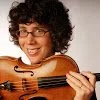
Early Music & Modern Folk with Andrew Arceci
This transcript is linked to the podcast and video versions with show notes for links to the music featured and more.
Andrew Arceci:
The frets are not fixed like a guitar, but on lute, viol and other earlier instruments, and in fact many world instruments, the frets are movable pending the tuning system that is being used. But the frets can make tuning difficult because of course you still have to adjust, but you have to adjust differently than you would playing cello or bass. And what the fret does is it acts like the nut at the top of the instrument. And so as you play behind the fret, it produces a very open sound.
Leah Roseman:
Hi, you’re listening to Conversations with Musicians, with Leah Roseman, which I hope inspires you through the personal stories of a fascinating diversity of musical guests.Andrew Arceci is an Early Music Specialist who performs on the viol family and is also a founding member of Floyds Row ensemble. You’ll be hearing music excerpted from their new album "The Carlisle Sessions" and also from Andrew’s earlier album with soprano Elizabeth Hungerford “Love and Lust” of wonderful music from the 16th and 17th centuries. Andrew also speaks about the tragic loss of his father, a prominent paediatric oncologist and how Andrew established the remarkable Winchendon Festival in Massachusetts, which features series of free concerts of jazz, early music, classical, and world music with established artists. It was fascinating to learn about Andrew’s path from jazz and classical bass to art history and early music scholarship which he studied at the Peabody Conservatory, The Julliard School and the University of Oxford. Andrew got into some fascinating specifics about the intricacies of reading different forms of notation while playing in different temperaments on many different instruments. On a personal note, he shared the joys of his nomadic life with his wife the violinist Asako Takeuchi, and some of the experiences they have shared living in Italy and Japan with their children. You can watch the video on my YouTube or listen to the podcast and I've also linked the transcript. Have a look at the show notes of this episode on my website where you'll find all the links related to Andrew, different ways to support this podcast and other episodes you'll enjoy. Hey Andrew, thanks so much for joining me today.
Andrew Arceci:
Thank you for having me.
Leah Roseman:
Before we started recording, I should have asked you your last name, do you pronounce it Arcechi or how do you say it?
Andrew Arceci:
Yes. Yeah. So we use both "arseesee" in the United States, Arceci in Italy, and my wife is Japanese, so we spend quite a lot of time in Japan. There it's "Aruchechi", so you can pick.
Leah Roseman:
Yeah, that's cool. So how recent was the immigration from Italy in your family?
Andrew Arceci:
So my father and grandfather were both born in the States. One of my great uncles was born in Italy. My children and I have dual citizenship, but my father and I used mostly English. In fact, we just spent the last several years living in Italy. We were in Umbria, central Italy. We just moved to Japan about a month ago, so we're between many places.
Leah Roseman:
Exciting. So let's start with Floyds Row's new album that just came out. So this folk collective, it started back when you were in Oxford, right? In different configuration?
Andrew Arceci:
Yes, certainly. So Chris Ferebee and I, two Americans at Oxford, spent many days and nights discussing music, history, et cetera, on the street called Floyds Row. And he put together a project for his doctoral project, which included myself, Alastair Anderson, a fantastic English concertina player, and a few others. And those initial projects led to what became the Oxford Sessions. When Chris and I moved back to the States, we toured with a few American musicians and then we quickly realized that with travel logistics, several of us have young children, that touring full-time would be quite difficult. So we focused more on a project-based approach. And we did tour for several years, and then this album, the Carlisle Sessions, was recorded in Carlisle, Massachusetts.
Leah Roseman:
So let's talk through this album and play some short clips for people. So track one, George Washington's Favorite Cotillion. So this accordionist, he plays mostly for dance.
Andrew Arceci:
Exactly. So his name is George Lykogiannis, and I met him in Baltimore, and then we overlapped when I was in New York. And when I moved back to the States, I reconnected with him, and he's been a central force within the ensemble the last several years. So he found this tune, transcribed it, arranged it, and it features himself, George, Chris, and another George on percussion. So that first track is just a trio and then it launches into the full ensemble.(Music: The Carlisle Sessions clip track 1, Floyds Row)
Leah Roseman:
And how about the title? What is the meaning of this really?
Andrew Arceci:
Unlikely. It's probably just a title. It's probably an old tune that came from the British Isles, possibly originated in the United States, but there are a number of titles associated with this tune. Some just reference George Washington, others reference other names. But it's fun to think about, but who knows? We don't know the real story.
Leah Roseman:
Okay. So it's not your title?
Andrew Arceci:
It's not our title. Okay. The only original track on the album is this tune Robin Hood by Chris. The others are mostly anonymous tunes that originated in the 17th century or 18th century and at times earlier. But some of what Floyd's Row does is we look at these old tunes, mostly anonymous tunes that have existed for generations, and we enjoy tracing that history. We enjoy exploring different renditions, how melodies changed, how harmonies may have changed, how lyrics will often be changed to suit.
Leah Roseman:
Yeah. You had just mentioned the final track,"The Song of Robin Hood and his Huntsman", this newly composed song from this old text. So maybe we could just go to that
Andrew Arceci:
Sure. So Chris pursued a degree in contemporary classical music, but he has maintained interests in earlier repertoire, early poetry, early history within the British Isles, of course, which overlaps with early American history. And the texts are quite old, but he put this text to new music. I mean, there is some overlap with traditional approaches, but it's a newly composed work and I think it's quite effective. It fuses some of that history to what we do. So there's an element of old within the new, but that's very much what Floyds Row does is that we, again, we try to trace some of the histories of these tunes and then experiment and come up with an arrangement and a rendition that works for us. Three of us work within historical performance. So Asako, Emily, the soprano and myself work within historical performance. But Floyds Row is very much not an early music ensemble.
I mean, we pull from historical material, but we very much are not presenting it in a historical way. We include historical repertoire, but we try to reformat that. And for us who work mostly within historic performance, it's quite liberating to experiment, to bring in new ideas. And then of course the musicians, we all have slightly different backgrounds, so we all bring a slightly different flavor, slightly different sound to that.(Music: clip of track 5 The Carlisle Sessions, Floyds Row)
Leah Roseman:
Do you know the RUCKUS early music guys?
Andrew Arceci:
Yes.
You must. Yeah. So I had Clay Zeller-Townson on last year.
Oh yes. I know Clay.
Leah Roseman:
Yeah. Were you at Julliard together or just from the community?
Andrew Arceci:
I'm not sure if we overlapped. I was at Juilliard for two years. I was part of the inaugural class there for historical - I think he came later. I think he was later, but we overlapped some in New York and we've certainly played several gigs together.
Leah Roseman:
Yeah. So let's talk about, well, the soprano Emily Noël, the second track is one of these ballads, Henry Martin. So maybe you could talk about the song a little bit and then her -
Andrew Arceci:
Sure. So Henry Martin is another one of these tunes with many versions. A lot of these tunes, the melody will change. Sometimes there will be a major rendition. Sometimes it will be changed to minor. The lyrics will often change. So there is a collection of versions. And for this, as well as most tunes that we do within the ensemble, we try to find some of these versions and then pick and choose. But Henry Martin is a long ballad and it certainly has a traditional element. We pushed it a little further, of course, with accordion percussion and some of the string techniques that we use. So it pushes into contemporary classical music. I wouldn't say it's wildly avant-garde, it's not, but there are some classical elements that we brought in, and that's very much what we do, especially since most of us are classically trained. And I met Emily in Baltimore.
She was pursuing a degree in opera performance and I was pursuing a degree in classical bass. And we worked together as students and then of course as young professionals, and we've known each other for about 20 years now, so it's always a pleasure to work with her.(Music: clip of track 2 Carlisle Sessions, Floyds Row)
Leah Roseman:
And you started with art history as well.
Andrew Arceci:
So my initial plan, I did quite a lot of classical and jazz through the teenage years. So I was planning to enter conservatory to do a joint degree in classical bass and jazz bass. And then within that first year, I was exposed to viola de gamba, violone, and just some of these earlier ideas. And within that first year, I started pursuing viola de gamba and violone quite seriously. And these interests with earlier repertoire, I think led to art history. So I ended up doing a degree in art history as well, which has inspired and really influenced some of how I think about early repertoire. Of course, there are no recordings, so the aesthetic is in the art. And especially for Renaissance music, for Baroque music, that aesthetic is important and you can see it in the art and you can try to think through that visually, but then bring that back to the music.
Of course, there are treatises too, which one needs to read if you're pursuing historic performance. There are a number of Renaissance treatises, Baroque treatises, and classical treatises that are central to understanding 18th century music, which is mostly what I do. But yes, I think a combination of the treatise research and the visual arts are quite helpful.
Leah Roseman:
What elements of that aesthetic? What do you mean by that?
Andrew Arceci:
I think the shading, so how light is used, how colors are used. For instance, I think much of Baroque repertoire works within a certain palette. For instance, there are many shades of red or whatever color, but there are many shades and how to understand that and how to use that with shaping textures, shaping lines. Much of the art is dramatic, and so we hear that in Baroque music. And somewhat related too is that I think when we are looking at earlier forms, we often are looking back. So if one is pursuing Mozart, Haydn, Beethoven, Brahms, and we kind of look at that back. And I think when you start looking forward, if you start looking at Renaissance music and see how that led into Baroque music, and then of course how these composers worked and how they transitioned into say the Rococo or the classical style, it makes far more sense.
And it's the same thing with instruments, how instruments evolved. When you're playing on an early harpsichord or fortepiano, well, it feels different, but I think any musician sitting down to do that would approach that music very differently than playing on an 88 key keyboard. And so I think that trajection is important where you take a step back and look through earlier repertoire and then kind of think forward as opposed to the backward.
Leah Roseman:
Yeah. Yeah. I did study some Baroque violin with Stanley Ritchie, and then I did play for a number of years, a lot of chamber music. And getting to know that 150 years before Bach as a violinist was incredibly useful and inspiring.
Andrew Arceci:
Yes, definitely. I did a few gigs with Stanley, but I think regardless, even if one is not working within say earlier repertoire, let's say if one is taking a traditional approach doing mostly 19th century, 20th century repertoire, I think it's important to understand that history and understand how one's instrument evolved, how it changed, maybe why, and for us, how bows changed because that of course shapes what we do and what we can do. That was one of the, I think, major differences when I started doing more with violone and baroque bass. You're quite limited in a good way to what you can do with these instruments, with the bows and especially gut strings. They just don't work the same way. They don't respond the same way, but that influences what you could do with the music. And again, same thing with when you're playing a keyboard because just visually you can see.
And I think it's important to have that knowledge. So I see more and more schools introducing basic elements of this, which again, even if you're not specializing in early repertoire, I think it's important if you're playing Bach or later repertoire.
Leah Roseman:
I was just thinking about what you were talking about the art. And have you done concerts where you've presented slides of baroque art married with music?
Andrew Arceci:
I've done a few programs with slides. I've worked with a number of museums actually. So coordinating music with an exhibit or if there are a collection of paintings, sometimes I and/or colleagues will put together a program that can incorporate that.
Leah Roseman:
Yeah. I mean, just food for thought, what you're saying about colouration, it really piqued my interest. It'd be interesting to do sort of a lecture recital, but in a dynamic way about that for people.
Andrew Arceci:
Definitely. And I've done several lecture recitals, which I think many of us who pursue earlier repertoire are naturally interested in these sort of parallel worlds between the visual arts and the performing arts.
Leah Roseman:
Yeah. So before we leave Floyds Row, I wanted to go back. So you mentioned Chris Farabee who'd founded the group with you. So the track three, how do you say it? Jackaroe?
Andrew Arceci:
Yes, Jackaroe.(Music: clip of track 3, Carlisle Sessions, Floyds Row)
Leah Roseman:
He plays various plucked instruments. And you mentioned your wife Asako, she's on this album as well.
Andrew Arceci:
Yes.(Music: clip of track 4, Carlisle Sessions) I was kind of curious, I'm married to a violinist as well and we work together. How are you navigating music for your kids? Are they too young to really...
But to answer your question, our kids, we have two children and our daughter plays violin. She studies with my wife and our son plays trumpet. So I think he didn't want to play a string instrument, so he was struck by the trumpet and is quite good, but right now he's obsessed with basketball.
Leah Roseman:
Okay, good for him.
Andrew Arceci:
So no pressure to work in the arts. My wife and I know it's quite difficult. And of course we both travel quite a lot, so we switch off with the children. Sometimes we'll tour together and the kids have been on tour with us, so they're pretty well traveled for young children.
Leah Roseman:
Actually, let's just talk about track four, Maiden Lane/Kettle Drum, because it starts with you on Gamba (Music: clip track 4). Then there's this great percussion solo with George Lernis.
Andrew Arceci:
Yes. So Maiden Lane, which segues into Kettle Drum, during those years when we were pursuing some of this repertoire, we had a number of variations, a number of versions of these tunes, and this was one rendition, and it basically opens with a Lyra viol, so somewhat improvised as if someone was sitting down and just kind of playing with ideas, and then that launches into the tune. And yes, and then of course, George Lernis has a fantastic percussion solo. He and I did a gig together. I think we were immediately struck with each other's playing, and we bonded quickly, and he was certainly a central element to the Carlisle Sessions, and of course is featured here on this track. And then we come back in with this tune, kettle drum.(Music: clip of track 4 with percussion solo)
Leah Roseman:
It must be that your early background in jazz helped with the improvisation in early music.
Andrew Arceci:
Definitely. And in fact, I was just discussing this with someone else, that there is a parallel here because early musicians, I think in general, most genres expect and encourage an element of improvisation. I mean, even in classical music, we have some of that. For instance, some artists will improvise cadenzas, but the idea of improv is certainly not new. I mean, it didn't originate with jazz. In fact, there are several early treatises that discuss improvisation, how to take a melody and create divisions, so variations. And these ideas are certainly to renaissance music. I think there was, of course, within Baroque music, one is expected to ornament, and it's not just random ornamentation. There are rules, there are approaches. So the central idea is similar to jazz where so much of what happens is off the page. Much of what one does with renaissance music and baroque music is off the page like jazz where you have a chart and you're expected to do something with it.
So I think that is central. And then the other idea is Basso Continuo, which is a shorthand system, and that is very similar to jazz because you basically have a bass line with numbers that suggest the harmony. And then of course, the player can decide how to present these harmonies. And there's an art to that too. There's an art to not just playing the right harmonies, but to rolling the chord a certain way or how to sustain a chord if a keyboard player is playing organ or if you have a bowed viol player or a bowed cellist, how to influence those notes based on the information provided. So I was naturally attracted to that kind of music making where there's a sketch, but each artist is expected to do something and to bring something. I think one of the most valuable classes I took was probably a continuo class and learning how to read, but to really interpret these numbers basically.
Leah Roseman:
Who was the teacher for that?
Andrew Arceci:
So initially it was connected to Lute tablature, so Mark Cudek at Peabody. And as I was pursuing early repertoire on viol, I was also learning this system called French Tablature, which is used within Lute Music. So it's basically Tablature in the modern sense, but it has a series of lines with letters, not numbers. So A is open string, B is first fret, C, et cetera. And so I was doing that and then also learning Continuo. And one of the early keyboard players I worked with also in Baltimore, Webb Wiggins, and then I studied with several people in New York as well. But I think that idea of harmonic language is very different than playing in an orchestra, even though you're within the sound, but the way that it's shaped is totally different. And being one bowed player, or sometimes if there's cello and bass on a continuo line, how to play off each other, there's a special rapport like a jazz trio or quartet.
Leah Roseman:
So your artistic director of the Winchendon Festival, I had to look up where this town was. And actually Floyds Row, you're going to be playing with, speaking of Americana, Chris Moyes, singer-songwriter.
Andrew Arceci:
Yes. So the Winchendon Music Festival is held in Winchendon, Massachusetts, which is a very small town on the border with New Hampshire. Winchendon is about plus minus 10,000 people. So it's a very small town. And the backstory is, well, my family's from Winchendon, and my father was killed riding a motorcycle 11 years ago, and he was buried in Winchendon. So I asked a few colleagues to join me, and we put together a set of three concerts basically as a memorial weekend. And there was interest in the music making. So the next year we did another set of concerts, and then it just evolved into what is now the Winchendon Music Festival, which is a nonprofit. There's a board. So there was no long-term plan. It was a series of... Well, the first year was just three concerts over a weekend, and then it evolved into several programs each year.
But now it's very much something, and it was a side project, which is very involved, but I try to ensure that we have interesting programs. So I will usually lead one or two programs. My cousin is a jazz musician and he has performed at the festival every year. And then often when colleagues are traveling through Boston or New York, I try to encourage them to come up, and sometimes we could do a run out, say, to Winchendon. So we've had a number of just really fantastic musicians, and Winchendon is about two hours from Boston, and there's no museum. There are some cultural events, but it's limited. And the festival has worked very hard to offer a variety of programs. So we offer usually classical jazz and world programs each year. And programs are free to the community. Of course, it's very hard to sustain because the board and I have to ensure we have other grants that can pay colleagues, insurance costs, administrative costs, et cetera.
So it's a very hard model. And I don't think something like this could work in a major city, but it's worked for us. And in a way we have to prove the festival's worth each year because we've of course write grants, but we also have invited businesses and patrons to contribute directly. So in a way, if people enjoy the programs, and thankfully they have, they have contributed to sustain the festival. So it's a unique model. I mean, in a way it is a business model, but I mean it's a nonprofit. And there's an educational component too that I've noticed over the years that some people who were just attending the classical programs or just the jazz programs attend all of them now. And so I think because the programs are free, people have a chance to explore different genres. And of course I invite many of my colleagues from other genres to talk about their instruments, their languages, their views of life.
And so there's an element of, there are many ways to think about music and there are many ways to think about life. So we've tried to have artists who are not just good, but who have interesting stories and who can talk with audiences. The venues are quite intimate. Well, the first several concerts took place at a congregational church called Old Center Church. And that was, as I mentioned, the 19th century congregational church, beautiful acoustic. And the last several years we've used a salon room at the Historical Society for some of the more intimate programs. So for instance, lute or we just had solo guitar and this salon room works quite well for one or two musicians. And then we've used the library as well as another church. So it depends on the program. But yes, I mean the festival has evolved into something.
Leah Roseman:
Andrew, I'm so sorry about the sudden loss of your father.
Andrew Arceci:
Yeah, it was tragic. We actually overlapped together in Chicago the week before. I was there for concerts. He was there for a conference and our schedules just kind of overlapped and we had a very nice dinner together in Chicago with two of his colleagues. And then a week later he was dead. So he died just before my son was born. So it was a very difficult time. And I think in full candor, I probably channeled some of that energy into the festival. But probably for about six months it was quite difficult and it was just a very confusing time losing my father and then becoming a father within such a short time. But Winchendon is a small town and people, of course, they knew my father. My mother is from Winchendon as well, both sets of grandparents. And I still have family there. I never lived in Winchendon, but it's a very special place.I mean, all my relatives are buried there. My father's buried there. And again, I still have family there. So it's an important location on the planet, which because my wife and I travel so much, it's one of the grounding places.
Leah Roseman:
What would you like people to know about your father?
Andrew Arceci:
He was a pediatric oncologist, but he loved the arts and my mother and father were both quite supportive of my interest in the arts. He was very busy. He traveled quite a lot and of course was busy with his patients. I think one of the lessons I learned, not necessarily directly through him, but sort of learning about what he did is that life is not fair. I mean, he was taking care of children with cancer and many of them died. And so there's this, I don't mean to be, not that this has a negative quality, but I think that one should live one's life because you never know. I mean, both seeing what he did, but also what happened. And he knew the risks involved, but he loved riding a motorcycle and in a way he died doing something that he loved. But it's been 10 years, almost 11 years, it's still quite hard just given the nature.
And it was prolonged. The driver fled the scene and so it prolonged longer. And so it took time for us to, not that one finds closure, but because it was prolonged, it made it much harder. Eventually the individual turned himself in and was jailed, but still, I mean, regardless, it just was a difficult situation. But my children will know about my father. I've seen photos and they know some of the stories. And I think that's some of what we do in the arts too, is that we prolong memories and traditions, which is important to the human spirit.
Leah Roseman:
I wanted to get into your really incredible album with Elizabeth Hungerford, Love and Lust.
Andrew Arceci:
Thank you.
Leah Roseman:
She's a really, really incredible singer and we'll talk about some of the tracks and the different colors and so on. But when I looked her up, looks like she's a cook now.
Andrew Arceci:
Yes.
Leah Roseman:
Cookbook author.
Andrew Arceci:
She moved to London with her family and she was there for several years and then she moved back to the States. And I think we did something together about two or three years ago, but we haven't been in touch much since then just because lives become busy. But one of her second interests certainly was cooking and then she put together this cookbook. So I don't think she's singing too much now, but she and I started exploring some of this repertoire together and every concert someone would ask about, is there a recording? And so we started thinking about the idea and we were quite young when we did this album, so we put together a fundraising campaign and we secured the money to have a location, engineer, et cetera. And yeah, I basically arranged, and since we were talking about improvisation, I improvised much of the accompaniments on some of these tunes.
Some of them are written out. For instance, this tune Tobacco by Tobias Hume. He used a system called French Tableture. So that music is actually written out. (Music: clip of "Tobacco" Love and Lust album)
But many of the other tunes, there's just a vocal line with maybe a bassline or maybe some suggested harmonies. And she and I experimented with ideas, of course, textures. And yeah, the result was this album. I mean, we experimented with ideas for probably at least a year, maybe two years doing concerts together. And then we recorded this repertoire, which is still, it was one of the most enjoyable projects just because it was so intimate and we tried to have... We were limited in a way because just soprano in one instrument, but it also made us explore as many options for myself, textures with pizzicato, with the bow, playing one line, playing double stops, rolling chords, et cetera. So it was fun to experiment with that.
Leah Roseman:
Yeah. Yeah. You mentioned that tune Tobacco. I mean, it really brought a smile to my face to listen to the lyrics.
Andrew Arceci:
Yeah. Many of his tunes have these comical titles. There's a tune called My Mistress, Hath a Pretty Thing, Touch Me Lightly, these kind of playful tunes. And most of these works are quite short, but there's a collection of these tunes. In fact, I don't remember. I think we recorded Tobacco and I think I recorded five or six other Hume pieces, maybe Touch Me Lightly and a few others. But yeah, the collection is fun.
Leah Roseman:
Mostly. There's Death by Hume.
Andrew Arceci:
Of course. (Music: clip of Death from Love and Lust)
But it's interesting because in the collection, Life follows Death in the collection, and that's a subtle... Well, I mean, I'm sure it was a decision that was made either by him or by the publisher.(Music: clip of Life from Love and Lust)
Some of the pieces are quite profound. And I think when we're looking at this earlier repertoire, some of these ideas, for instance, Col legno using the back of the bow, using the wooden part of the bow, I think this is one of the earliest references where Hume notates in the music that the passage should be drummed with the back of the bow. He doesn't use col legno, but he's suggesting that. There is another reference where he is suggesting... I mean, he references pizzicato, which we think of as something normal, but I mean, it's referenced in the score and he writes that the next several letters, because it's written in Tablature, should be plucked with the finger. And these are early examples of composers experimenting with different sounds. And so when Elizabeth and I started putting our arrangements together, I used Hume's collection as a source. So basically as an example and looking at how he used that plucked sound, but also using the wooden part of the bow, how he notated chords.
Well, I used that as an example to create some of the accompaniments with Elizabeth, but of course we had a discussion because how she was singing a phrase or what the lyrics were would influence what we would do.
Leah Roseman:
So I first heard this album, I was aware of it, and it was one of these mornings where I just got up far too early, so I though I'll just put on my headphones and listen. So I listened through to the whole album and it was so beautiful, but I didn't really know what I was listening to, so I hadn't read anything about it. So it was interesting afterwards to kind of explore. So I'll tell people there's a lot of actually solo viol playing as well as the songs.
Andrew Arceci:
Yeah, probably about a third of the album is unaccompanied viol. Mostly works by Hume. I believe there's a work by Christopher Simpson. The arrangements came from this tradition of what's called Lyra viol. It refers to an instrument, but also a style of playing.
Leah Roseman:
Who was this guy, Hume?
Hi, just a quick break to let you know which episodes I’ve linked in the show notes for you, with lutenist Elizabeth Pallett, Clay Zeller-Townson of RUCKUS early music, Kelly Thoma the Cretan lyra player, Shirley Kazuyo Muramoto the koto player, filmmaker and researcher of how the music and traditional arts of Japan which were practiced in the WWII American concentration camps. , Gilad Weiss with a visit to his music studio and instruments from Turkey and Central Asia, Sarah Jeffery of Team Recorder , and cellist Dorothy Lawson of ETHEL ensemble. These episodes are linked along with my catalogue of over 250 episodes since 2021.Consider buying me a coffee on my Ko-fi page or buying some unique podcast merch. You can also review this podcast, share it with your friends, and follow on your podcast app, YouTube, and social media. All this helps spread the word. Thanks!
And who was this guy, Hume?
Andrew Arceci:
He was a sailor. I believe he was a captain, and he wrote a number of these short pieces that are entertaining, and as we discussed, some are profound, but this tradition of viol playing comes from lute playing. There was quite a lot of overlap between accompanying a voice with lute as well as accompanying a voice with viol. And because I studied tabliaure with Mark Cudek in Baltimore, he's a lute player and cittern player, I think Bethy and I started incorporating some of those ideas. And actually the backstory to all of this is that Mark, who was central to this project, Elizabeth and I were both in the Collegium, and Mark gave us this piece, Amarilli, by Caccini, and he basically just said, "Do something interesting with it." I've used a similar idea in some of my teaching where once a student has enough knowledge, let the student explore.
And so Mark's suggestion basically do something interesting with it led us to an arrangement that basically sparked the entire project. I still think back to that where Bethy and I, I remember just Mark handing us this sheet music saying, "Do something interesting with it." And next week we had a version, he made some suggestions, and then we came back with a second version and yeah, that basically sparked the entire project.(Music: clip of Amarilli from Love and Lust)
Leah Roseman:
I was just thinking, I had on Elizabeth Pallet, the British lutenist on this series a few years ago, and we got into a little bit about how the lute dropped out of favor for the guitar, but the same thing with the viol family is that the cello took over. So not everyone listening will even be familiar with the viol family.
Andrew Arceci:
Yeah, so viola de gamba is... Well, I should clarify that gamba means leg in Italian. So the instrument either sits on or between the legs, and there are several sizes of the viol. There's a treble viol, which is quite small, which plays in the range of the violin. There are other versions, there's the pardessus but traditionally there's the viol family and these instruments worked in what is called a consort. So you would have several viols of different sizes, and sometimes a family would play together. Often a luthier would make a collection of viols, so the luthier would basically ensure that the dimensions were similar as the instruments expanded. So you would have several smaller viols, you'd have several mid-range viols, and then the bass viol, which is the most popular, and the late Renaissance into the early Baroque, the bass viol became central and much of the solo repertoire, both unaccompanied and other forms were written for the bass viol.
So I work on viola de gamba, mostly the bass viol, the violone, which is essentially baroque bass and modern bass. And for me, when I was pursuing classical bass, I was interested in the history of the bass, and of course with art history, and those interests led to violone, which led back to the viola de gamba.(Music: clip She Loves it Well, Love and Lust)
Leah Roseman:
You have to mention the frets.
Andrew Arceci:
Yes. So all viols have frets and they're movable, so like the frets on lute. And as one specializes in early repertoire, we work in several temperaments, so pending the key, we can adjust the frets for tuning purposes. The frets actually don't help with intonation. Sometimes they make it harder because you can't adjust. I mean, you're a violinist, so you know, but if for any of your listeners, the frets are not fixed like a guitar, but on lute, viol, and other earlier instruments, and in fact, many world instruments, the frets are movable pending the tuning system that is being used.
But the frets can make tuning difficult because of course you still have to adjust, but you have to adjust differently than you would playing cello or bass. And what the fret does is it acts like the nut at the top of the instrument. And so as you play behind the fret, it produces a very open sound. And during this time period, vibrato was used as an ornament, so vibrating and kind of warming the sound was used as an ornament. And there are different versions, I guess, different options with vibrato using what we think of now as a traditional vibrato, but there are other ways of maybe using two fingers to kind of bend the sound a little. And all these things were ornaments that were used certainly through the Baroque.
Yeah, I just became fascinated by this repertoire. I think as a bassist, we have such a limited repertoire that I was interested in earlier, say, classical repertoire, and much of that solo bass repertoire was written for an instrument called the Viennese bass or the Viennese violone, which is not the four string bass. So much of it doesn't work that well. I mean, it can be played on the modern bass, but when you take that music and play that on a five-string Viennese bass or a five-string Viennese violone, it just makes sense. I mean, you can immediately tell what the composer was thinking because the handshapes work. And likewise, much of the bass repertoire is taken from cello and/or the viola de gamba. So as I was looking back through bass history, both in terms of repertoire, but also the construction of the bass and how that evolved, that led to the viol, which is basically a precursor to the modern bass.
So these three instruments, even though when someone references viol, it can refer to any one of these viols, and same thing with violone, which is an ambiguous term. It just means viola in the Italian sense, a large viola, which means a large string instrument. And it referred to three, four, five, and six string instruments that were used throughout Europe. So now we say violone and we usually mean baroque bass, but it can refer to a number of instruments. So long story short is that if one is working in this industry, I think it's important to be familiar with these instruments and the tuning systems, but of course you can only take one or two instruments with you on a gig and if you're traveling. So one has to be practical too, in the modern sense. We live very differently, we travel very differently, and we program differently.
So I've definitely been on projects where I wish I had another instrument and you just have to make it work.(Music: clip of Chi Passa Per 'sta Strada)
Leah Roseman:
So just before we leave this beautiful album with Love and Lust, I wanted to mention... Oh yeah, track three with the Col legno ricochet accompaniment, Chi Passa per 'sta Strada by Azzaiolo.
Andrew Arceci:
Yeah. So it's a playful tune, and I think this was one of the tracks where we experimented with a number of versions. It's interesting when you're in the studio, sometimes when you think something works in a live setting, doesn't necessarily work in the recording atmosphere. So we experimented with this quite a lot and we invited the engineer to offer feedback who helped produce the album as well. And I think in the end, we found a good version. I'm sure if we sit down and do that tune as well as the others again, we probably would do them differently, which is the fun of some of this repertoire. And I think that also leads back to some of the work with Floyds Row is that if we return to any of these tunes, I and my colleagues would probably do them very differently, not necessarily better or worse, but just because it's a different day and we could be experiencing something differently.
Leah Roseman:
And I know that viol, in terms of the family, people would be reading different clefs. Does your brain, can you process that?
Andrew Arceci:
Yeah, I think within the viol world, we use a number of clefs. Most of the solo repertoire is written in alto clef, and occasionally it will switch into tenor or mezzo soprano clef, which we don't use much in the modern world, but they're just movable C cleft. The viol also, some repertoire is written in treble clef. Of course, the accompanying music, if you are playing a bassline, that's written in bass clef. But there's a sense of flexibility with this repertoire, both in terms of the music making, but also just how the brain works because with this Lyra viol tradition, there are different tuning systems. And so usually the tuning system is written before. And so when you're reading modern notation, it would be very difficult to read that if you're using a different tuning system for each piece. But because it's written in tablature, you're thinking in terms of the fretboard.
So that is an advantage that tablature has over say modern notation. And many of the pieces written by Hume and other composers use Tablature because they experimented with different tuning systems like many rock guitarists or modern musicians. Sometimes a guitar player will tune the low E string down to a D and experiment with other tuning systems. That idea was used during this time period as well. There are times when you're thinking in one system and it can be very difficult to maintain one's thinking in the current system. But yeah, that's part of the industry though, especially playing viol and other instruments, being able to work in different tuning systems, being able to work in different clefs. And then of course, with violone, there's quite a lot of variety as well with three, four, five, and six string instruments. And within that, there are different tuning systems.
And then with modern bass, I will use mostly standard tuning EADG from the bottom up, but often for certain repertoire, for earlier repertoire, I'll tune the low string down to a D. It makes the instrument far more resonant. So DADG. Yeah. So I think that idea of experimenting and being flexible is central to this. Plus, my colleagues and I use a number of tuning pitches. Much of Baroque music is written... Well, it's a modern convenience, but we use A415. They're Renaissance tuning systems that are higher and lower. This idea that classical music is now performed at 430 is... I mean, that's a modern approach to that. I mean, because Historically, people would have tuned to basically whatever the organ was. And this idea of A430 or A440 in the modern sense as being fixed is a modern idea. It makes it easier to travel and of course, there are conveniences there where, especially for wind instruments, but even for us with strings, knowing ahead of time that the A would be at 415 or 430 or 440.
Leah Roseman:
Yeah. It's interesting with the different tunings and reading tablature because your brain has to work in such a different way. It's like
Andrew Arceci:
Speaking several languages.
Leah Roseman:
I was going to say. So one of my special interests is definitely languages. I've studied a lot. And I started studying ASL at the beginning of the pandemic. And I remember my teacher, this was online, she said, "It will take a while for your brain to understand this is a language because it's visual." And I remember the moment that happened and it was just like a switch went on. And now when I'm searching for words, often the sign will come to me, which is really fascinating. And I'm curious, you must speak some Japanese.
Andrew Arceci:
I do. So I speak more Italian than Japanese, but Japanese is, it's such a different way of thinking about language, the word order, but just the visual element as you mentioned with that. I think it is accurate that reading several notation systems, working in several tuning systems, yes, there's an element of being flexible and being able to switch quickly is a skill. And of course, I remember practicing that. If you're playing two instruments on a gig and you need to switch, you have to practice switching because that switch can be difficult in a different setting. So that idea of switching between viol to violone and also just for the hand, because so much of what we do is physical. But to answer your question with language, yeah, I'm slowly learning some Japanese. I can understand more than I can use, but that's because processing the language, I have to think in a very different word order.
And there are many subtleties in Japanese, for instance, there are many levels of politeness. So using the language in a business setting is very different than using language with a friend or say with my wife or with her parents or her grandmother who just turned 101. So that is very hard and I have struggled with that. But there is a visual element because there are three different writing systems there. And I understand Hiragana and Katakana, Katakana is used for foreign words, but Kanji, the Mandarin symbols, it's a very visual way of thinking about language and sharing information. I mean, you can share quite a lot of information in a short period just because you have a collection of symbols, a collection of ideas. And that has been both challenging, but also just enlightening to understand how information can be relayed in such a different way.
So my wife is the linguist. I try to keep up.
Leah Roseman:
And you mentioned you spent several years living in Italy?
Andrew Arceci:
Yeah. So it was basically at the end of the pandemic
When, I mean, we, like so many people lost, we probably lost about six months of work within 24 hours. And we were doing some teaching, but we basically left for Italy just for one year and then we enjoyed our time there. So we stayed. And I was back and forth quite a lot between Italy and the US. So I felt like I was living between places for much of that time. But my wife and kids were more settled in Italy, in Umbria, central Italy. My family is from Fano, which is in Marche, but it was a nice experience. It was certainly an adventure. Italy is beautiful. Nothing works. So it was definitely worth the adventure. As I mentioned, we just moved to Japan and I joke that we went from one extreme to another. So it's been refreshing to be in Japan just because of course the trains run smoothly and there's an infrastructure there that is reliable.
And for us, because we travel so often, it's been nice to have that. I don't know what we'll do long term, but we're there for one year.
Leah Roseman:
Wonderful.
Andrew Arceci:
Yeah, another adventure.
Leah Roseman:
And you're also a composer.
Andrew Arceci:
Yes. Less these days, but I do very much enjoy arranging and composing. And I think that those skills are connected with just general music making. And again, this idea comes from the historical approach where you look at any one of the major composers and whether it's Bach or Handel or Beethoven, any composer, and many played at least two instruments, if not more, and many arranged, they composed. And I think that there's an element of that which I think we lost some of that in the 19th century, certainly into the 20th century where we specialized, where a conductor is a conductor, a composer is a composer and a performer. And those roles, they just overlapped with one another through history. And I just fell into some of that as well, where at times I will work as an arranger or composer.
I direct the festival, but I also will occasionally direct ensembles, usually from an instrument. I'm not standing there with a baton, but I usually direct from an instrument. And there's no reason why a viol or a violone player or even a bass player can't do that. Now we think of a leader as the first violin or usually a keyboard player. And there are certainly good reasons why that role should do that. But I think looking back, being a well-versed musician meant being able to arrange, being able to compose, being able to play two instruments just to have a different way of thinking. But also, I think it's very humbling when you're looking at a blank page and you realize what someone like Handel did or what Beethoven did. It's easy to forget that, but when you're looking at a blank page, I mean, someone like Handel wrote that.
And it's the same thing for a visual artist too, when you're looking at a masterpiece and you think when you've seen it a thousand times, it loses a quality and then you realize there was nothing there before that DaVinci painted that. And so I think that idea is worth revisiting and I enjoy revisiting that because it's very humbling and it's also, it just makes you think about the arts very differently.
Leah Roseman:
Yeah. I was recently at a beautiful art exhibit where I live. We have the National Gallery here in Ottawa. And it was interesting because there was this artist, they had some of her contemporaries' art alongside and some of her mentors. And in a couple cases, she was painting the same scene as her friend and they had both paintings side by side. So in the same moment, a different interpretation of what they were seeing. It was really cool.
Andrew Arceci:
Yeah. I enjoy that. And as we were discussing earlier with Floyds Row, we definitely do that. I mean, whether we're recording or if we're doing something live, having several versions, having several renditions of the same tune is fun. And then you start thinking... For instance, there's a tune called Wind and Rain that we recorded. We have a forthcoming album as well. I think actually Wind and Rain is on that. That was recorded with guitar, violin, and soprano. And there's another rendition that we just did with piano, bass and the same soprano. The voice is the same, but they're vastly different experiences between the strings texture and then having this piano and bass. Floyd's Row tries to do that. We try to have several renditions of the same tune. Yes, I mean the notes are similar, but the textures are so different that it really invites different experience.
Leah Roseman:
In the show notes, I'll be linking a few things, including Floyd's Row has a YouTube channel where you have some of... In fact, I think your upcoming album, it must be some of these performances.
Andrew Arceci:
Yeah. We're quite behind with some of that. We have several concerts that we recorded that we just never released, mostly because we work with a number of ensembles and some of us have worked and some are still working at universities and life became busy. So now with the album, we've tried to check back some of this footage. So there are some clips from a concert that we did at Center Stage, which is on the Cape here in New England. Some of those videos are of some of the tunes that we recorded.
Leah Roseman:
I'd asked you about your life as a composer. I haven't heard your music because I couldn't find any, but you've composed modern works for Viola de Gamba, and also your Missa Brevis was premiered at the Wichendon Festival last year?
Andrew Arceci:
It was written, but we had to postpone the performance. The schedule was too tight and we didn't have one of the grants that made that possible. I'm hoping to program the Missa Brevis either in the spring or in the fall, but because we need additional funding, we had to postpone that. But the works for viol, I've written a number of unaccompanied works for viol. In fact, Floyds Row did one tune called Portrait, and I wrote that for unaccompanied viol and then arranged it with two of my colleagues in Floyds Row. I've done a lot of soundtrack work too where I'm sort of co-arranging or co-composing with composers. I did some work with Silent Witness, which is a British television series, and I wasn't credited as a composer, but I was creating many of those textures and lines. But yeah, I think there is a performance of Portrait online through Floyd's Row.
Leah Roseman:
Yeah, I've seen that video. Was it on your first album, the Carlisle Sessions?
Andrew Arceci:
No, that was not recorded. That will be on the forthcoming album, which is a live recording. So that will include this work called Portrait. But I've written, this feels like a lifetime ago, but I wrote two suites. I wrote a suite for Viol and Chamber Orchestra years ago, and then I wrote another suite for Viol and Chamber Orchestra. And interestingly, I met my wife on that project. I was living in England, but I was back in Boston doing this project with a group, and I was leading this suite that I wrote from Viol. Yeah, I haven't written anything like that recently. I mean, the closest would be the Mass, but that's very different than writing for viol. Long story short, I try to write when I can, but it's difficult to find the time just given other commitments. Of course, I have two young children, so I hope that I can revisit that.
But much of the work I do with Floyd's Row is arranging and/or composing in different elements of that. But the first album that we did, the Oxford Sessions, Chris and I arranged and/or composed everything on that album. So there are a few tracks there. And then the Carlisle Sessions just features this new work by Chris. And then the live album that will be coming out probably in 2027 features music by Chris, our colleague, George Lykogiannis and myself, along with several anonymous works.
I enjoy arranging. I enjoy composing, but yeah, with limited time... Choices. Yeah, one has to make choices. So the last several years I haven't been writing as much, although when I sit down with an idea, I wish I could pursue it, but I usually make notes and think I'll come back to it. I think it's very common for composers to do that, but it's not my full-time gig.
Leah Roseman:
So I thought, Andrew, it might be interesting. I mean, we didn't talk about your teaching, but we talked a lot about the fact that you're touring, you're doing projects all over the place. So in terms of just self-care and helpful habits, are there things that you stick to that help you with that kind of lifestyle?
Andrew Arceci:
Yes. I would say to preface, I would say that living between several time zones is very difficult regardless of what you're doing. I think maintaining a sense of balance between projects and touring to then having time to regroup both mentally but also physically. For instance, when we were living in Italy, I was back and forth. It was between Italy, other countries and the US, and it's very taxing, both certainly physically, but also just psychologically being between time zones and cultures. And so it can be difficult. I find it exciting, but it can be difficult. So I think having that time, because often when so much of what I do is project-based, so that means a week or two weeks will be very intense, and then I may have time, one or two weeks to regroup. And I think that is important, especially if you're doing very intense projects.
When we were living in Boston full-time, I wasn't traveling as much, so I was doing freelance work within New England, I was teaching, and there's still an element of that, trying to find a balance with work. But it is hard. We tend to work unusual hours, rehearsals and concerts, and it's also hard when if you're performing and your peak time needs to be 7:00 PM, 8:00 PM. If you're up early having a full day of commitments, it's very hard to then be in good shape. So I think I've learned ways along just by doing it and by experimenting. I think when I was younger, I probably would've benefited from, in addition to all the music classes and learning the trade, something about taxes, something as mundane as that. But it's an important element of working in the arts that is central, whether you have a full-time orchestral job or you're doing freelance work or teaching, whatever, it's less traditional.
And especially now, a lot of the algorithms just don't support what we do, having several sources of income, teaching, working between cities. And so it can be hard to navigate, and there are times when I think it's just frustrating. But then I think back to the traveling and some of the experiences I've had, which I've enjoyed. So I would say probably the balance is, I don't know, the suggestion or something that I've learned. And that may be different from time to time.
So Floyds Row is... We're doing several lecture recitals in Singapore next month, and then we won't regroup until March. So we'll be doing a short US tour. And those projects are very intense. I mean, it takes months of planning, of course, to coordinate schedules and details with venues or universities. And then it happens, and then you think we just had a very busy one week or two weeks, and then you need time to recuperate from that. So it can be hard, and it's much harder now with young children. So my wife and I both took a step back from... Even though we are quite busy, I mean, we took a step back from performing, from touring while the children are young. And then presumably we'll revisit that when they're a little older.
Leah Roseman:
Yeah. Yeah. My kids are well into their 20s and it changes a lot.
Andrew Arceci:
Yeah. Right now, the kids need us. I mean, of course we have to work, but yeah, I mean, finding that balance with travel or with a partner and/or with children is very difficult.
Leah Roseman:
Yeah. Well, thanks so much for this today. I really appreciated it.
Andrew Arceci:
Thank you for having me. It was a pleasure to speak with you.
Leah Roseman:
I hope you enjoyed this episode. Keep in mind, I've also linked directly several episodes you'll find interesting in the show notes of this one. Please do share this with your friends and check out episodes you may have missed at LeahRoseman.com. If you could buy me a coffee to support this series, that would be wonderful. I'm an independent podcaster, and I really do need the help of my listeners. All the links are in the show notes. The podcast theme music was written by Nick Kold. Have a wonderful week.