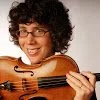
Ruby Colley and the story of "Hello, Halo"
Below is the complete transcript to my interview with Ruby Colley, the Ivor-nominated composer, violinist and sound artist. Like all my episodes, this is available as both a podcast and a captioned video, and the button link also takes you to the complete show notes with other important links! I’m so happy to bring you this episode with the British Ivor-nominated composer, violinist and sound artist Ruby Colley. She grew up with her artist parents and her brother Paul who is neuro-divergent and non-speaking. This conversation shines a light on her beautiful album Hello Halo with the brilliant Exaudi vocal ensemble. She composed this alongside her brother, transcribing Paul’s sounds and using recordings of his voice to make a vocal map of his life & relationships. You’ll be hearing music from this work as well as her project Overheard. Ruby spoke to me about the influence of Breton folk music and J.S. Bach and how she uses field recordings. You’ll also hear about how she has collaborated in some of her audiovisual projects with her mother the artist Kate Adams who founded Project Art Works, a visual arts organization that collaborates with neurodiverse individuals and those with cognitive impairment and high support needs. We talked about navigating music education, stepping away from competitive environments, the joy of improvisation and Ruby’s upcoming project inspired by the beauty of swifts.
Ruby Colley:
Giving both me and Paul a platform for some kind of artistic expression and just the general belief that anyone should be able to access not just kind of creativity and making, but the act of putting something out into the world is a way of saying that you are here, that you exist. And so art became a very kind of clear way for mom to advocate and champion people's personhood and agency.
Leah Roseman:
Hi, you're listening to Conversations with Musicians with Leah Roseman, which I hope inspires you through the personal stories of a fascinating diversity of musical guests. I'm so happy to bring you this episode with the British Ivor-nominated composer, violinist, and sound artist, Ruby Colley. She grew up with her artist parents and her brother, Paul, who was neurodivergent and non-speaking. This conversation shines a light on her beautiful album, Hello Halo, with the brilliant exotic vocal ensemble. She composed this alongside her brother transcribing Paul's sounds and using recordings of his voice to make a vocal map of his life and relationships. You'll be hearing music from this work as well as her project Overheard. Ruby spoke to me about the influence of Breton folk music and J.S. Bach and how she uses field recordings. You'll also hear about how she's collaborated in some of her audio visual projects with her mother, the artist Kate Adams, who founded Project Art Works, a visual arts organization that collaborates with neurodiverse individuals and those with cognitive impairment and high support needs.
We talked about navigating music education, stepping away from competitive environments, the joy of improvisation and Ruby's upcoming project inspired by the beauty of swifts. You'll find the track information for the musical excerpts in the timestamps and everything is linked in the show notes on my website. You can watch the video on my YouTube or listen to the podcast on your preferred platform and I've also linked the transcript. It's a joy to bring these inspiring episodes to you and I do all the many jobs of research, production, and publicity. Have a look at the show notes of this episode on my website where you'll find all the links, including different ways to support this podcast and other episodes you'll enjoy.
Hi, Ruby. Thanks so much for joining me here today.
Ruby Colley:
Thanks for having me.
Leah Roseman:
I have so enjoyed discovering your music and creative work and I listened the most to Hello, Halo, and also Overheard. So I'm hoping we can do a deep dive into both those projects and creative life. So the Exaudi ensemble, this chamber choir, did you know their work before?
Ruby Colley:
Yeah, I was aware of them, but I wasn't aware of just the full scope of what they worked with and they were recommended to me when I was kind of first R&Ding this idea. I was looking for a very specific vocal ensemble who would give this project the kind of fearless kind of respect that I felt it needed. And so they came recommended and they absolutely kind of met the day with that one.
Leah Roseman:
Yeah. I really, really love the album. I've listened to it many times. I find it's beautiful and inspiring and moving and fun is definitely fun. So I was hoping we'll be able to highlight several tracks although if you want to talk about every single track, we can have little clips and I can intersperse that with our conversation as well. So it's up to you, but I selected a few of them.
Ruby Colley:
Sure. Take it as it comes.
Leah Roseman:
Okay. So this was developed alongside your brother, Paul, who is neurodivergent and is non-speaking. So do you want to first speak to us about his rich repertoire of sounds and gestures and how that works?
Ruby Colley:
Yeah. As you mentioned, he's non-speaking, but he does have a toolkit of words. I guess they're kind of limited so he will use certain words for multiple contexts. So context is everything with Paul and also how he says certain things. So the main kind of hook of this project, Hello Halo, is that his main totem word is hello. So how he says it and to whom has a lot of kind of contextual meaning and so it can be whispered, it can be shouted, it can have a kind of genial upward inflection and that all has its own meaning. Over the years, you get to know Paul intimately and you get to know all of these different words with their context so you can understand what he means. And I wanted to give that its full color in the form of music.
Leah Roseman:
So I'll play an excerpt of the very first track, which is Hello, Halo. (Music: clip of track 1 Hello, Halo)
And I'm curious with you and your mom and his carers and his friends, have you discussed over the years the meanings that you each interpret from his various vocalizations?
Ruby Colley:
Yeah. Well, for example, just the other day one of his support workers was leaving and he kind of leaned over and he said hello to her and we immediately knew that that meant he meant goodbye, but he has his toolkit and that's what he's got to use. And so in that context, we all agreed that that's actually what he meant because of the way he said it and the context.
Leah Roseman:
I really enjoyed watching the beautiful documentary film you made about this. So I'll link that on YouTube for people in the show notes. And there was that scene where you're, I think he's listening for the first time to some of the music with the singers, maybe not the first time, but a time that you ... And it was so beautiful seeing that-
Ruby Colley:
That was the first time.
Leah Roseman:
Okay. That he was so enthusiastic and on board with it.
Ruby Colley:
Absolutely. Yeah. It was just a very clear moment of recognition, I think. And that's why I wanted to play it to him because a lot of the process was about involving him as much as possible also having his consensual involvement as well. So yeah, I'm really glad that he got to be part of that and really understand what it was about.
Leah Roseman:
Yeah. So he used to have more words that he's lost with aging and I gather that's kind of common?
Ruby Colley:
Right. I mean, I don't think he had more words. It's just he had different words, I guess. And one of our personal theories is that simply there's only so much information that he can hold and sometimes if certain words become superfluous, then they will get lost. It's a kind of use it or lose it situation. And yeah, there's a lot of words that he no longer uses. And so yeah, one of the movements is dedicated to those lost words. One of those words was the word hup. So it was like up, but with an H and he as a boy was very kind of transfixed with the sky and the stars and so he would use that word to bring attention to the sky, but within that would be birds stars and other meanings as well. So he would use that word again in different contexts and so one day he started singing Twinkle Twinkle in the back of the car, but with the word hup and we were all pretty floured because it was pitch perfect like a choir boy and so I brought that into this movement as a kind of quotation.
Leah Roseman:
Which movement is that?
Ruby Colley:
Echoes. (Music: clip of track 4, Hello, Halo)
Leah Roseman:
Yeah. I was also wondering about the track cosmology where they're reciting the letters.
Ruby Colley:
Right. So that movement is a little bit more kind of cerebral in the sense that it's specifically inspired from a drawing that my mom did called the Cosmology of Care.
Leah Roseman:
Oh, I saw that.
Ruby Colley:
Yeah. So they're all the acronyms for the systems of care within the UK. And as a caregiver, you get to know all of these systems a lot and they all get reduced to their acronyms, which can be quite overwhelming sometimes because there's a lot of them. So I started to kind of list them all from this drawing that my mom had done and I thought this could be rhythmic, this could turn into something. And I deliberately started from a place of spatial kind of introduction to the letters, but then for it to kind of gain momentum and fall into a bit of chaos as more and more acronyms are introduced until it eventually just gives way to the other things within the cosmology drawing that give a person's life meaning beyond these bureaucratic systems, which is choice of who's to spend time with being close to the sea, being in wild spaces, things like that.
Leah Roseman:
So that's on your Instagram, that's where I saw it. Yeah, I found it very moving. I was going to ask about that if you'd drawn it. If you'd like in the show notes, I could put that image if your mom would be interested because it's very meaningful.
Ruby Colley:
Absolutely. Yeah. You're very welcome to.
Leah Roseman:
Yes.
Ruby Colley:
I can send it to you.
Leah Roseman:
Okay. Yeah. So it's this beautiful graphic with circles and I think some of it, it's definitely for everybody, this quality of life. So if you want to speak to that a litle bit more, it's so meaningful.
Ruby Colley:
Yeah. And I think this is what points to the overarching meaning of the entire work is that it's meant to fly the flag for his humanity and the breadth and depth of his personhood and that's what this cosmology drawing points towards as well, that these are all things that we as humans all need in our lives to live fulfilling meaningful existences. (Music: clip of track 6 Cosmology, Hello, Halo)
Leah Roseman:
Did you experience some negative attention when you were growing up as a sibling?
Ruby Colley:
For certain, yeah. And it was the '80s. Yeah. It was like a different time and yeah, there was a lot of unwelcome visibility, I guess, and I found that quite painful and I also understood my brother in a more nonverbal way anyway. As siblings, we had an energetic connection, I guess, that wasn't typical of siblings. So I think as an adult, I wanted to be able to have that visible, but in a way that had more agency and self-determination.
Leah Roseman:
And I was curious about the notation for the singers. Were you using traditional notation or were there some different ...
Ruby Colley:
Yeah, mostly that took some time to develop and I worked with a scoring assistant to help develop that because there were a lot of kind of sounds that I needed to be kind of quite exacting. So we developed a key for a lot of the performance markers within the score and we spent some time at a residency to work over those. And honestly, Exaudi was so exemplary at just immediately understanding the score anyway. It really didn't take too much time, but yeah, there's certain sounds that required a little bit more kind of graphic interpretation and two of the movements, the duets were a little bit more open in those terms. (Music: clip of Duet 1, track 3, Hello, Halo)
Leah Roseman:
In many of your other works, and we'll get into it, you do use field recordings, ambient nature sounds particularly. And I was curious if you know the composer, Karen Power.
Ruby Colley:
I do. Yeah. I love Karen Power's work.
Leah Roseman:
Okay. Yeah. I had her on the podcast last year and I was curious if you've made that connection.
Ruby Colley:
Oh, okay. That's awesome. I haven't seen that, but I'd love to look that up and watch it.
Leah Roseman:
So this album was nominated for an Ivor Novello Award, which the UK is a great honor for the best choral composition. And getting that nomination, has that helped with visibility, getting more people to listen to it?
Ruby Colley:
I think it becomes a calling card and a kind of flag of legitimacy, I guess. I mean, I don't know if other composers feel this, but I'm always kind of questioning my validity as a musician all the time, self-doubt abounds all the time. So having those little moments of recognition means everything really. And yeah, it was real honor to be nominated.
Leah Roseman:
And the documentary, has it been in film festivals? Are you going that route with it?
Ruby Colley:
Right. So it recently showed at a conference called Classical Next in Budapest and that sat alongside some beautiful films including films from the LSO, the London Symphony Orchestra and it's specifically focused on inclusion in classical music. So I showcased the film there and got to represent the project as a whole.
Leah Roseman:
Wonderful. Just in that film, which I encourage people to see, it's not that long. It's what? About 15 minutes if I remember.
Ruby Colley:
Yeah, max. Yeah, 13 to 15 minutes.
Leah Roseman:
So you highlight Paul's creativity and photography and painting through his support artists. So this kind of creative expression, did that come early in your family that you knew this and you were able to help him?
Ruby Colley:
Well, both my parents are artists and the studio that you see Paul in as part of a wider organization called Project Art Works, which is the organization that my mother founded. And so the organization was founded on the back of both my parents being artists and both of them giving both me and Paul a platform for some kind of artistic expression and just the general belief that anyone should be able to access not just kind of creativity and making, but I think the act of putting something out into the world is a way of saying that you are here, right, that you exist. And so art became a very kind of clear way for mom to advocate and champion people's personhood and agency through art. And so I guess the philosophy of approach is to essentially allow or bring about the circumstances and environment where people have the opportunity to express themselves on their own terms rather than being kind of herded or managed in any kind of creative ways is ... And because we know Paul very intimately, we know that he loves people and that he loves studying faces.
So the photography came about that and his support artist, Georgia in particular, really helped develop his practice through having all of these inclusive means of him to photograph people.
Leah Roseman:
Yeah. That's so interesting to me. I was also wondering, I have a special interest in sign language and I was curious if some of his gestures are British sign language or if they're all just his own gestures ?
Ruby Colley:
Some of it will be macaton. So Makaton is an accessible form of sign language here in the UK. It's kind of like a simplified BSL, just in terms of the fine motor skills, it's less complex. So people who struggle with fine motor skills like my brother can access it a bit more. So he has very particular signs like plane and so sometimes he will just kind of approximate the gesture, but he'll lift his hand, we'll know what that means and he'll use this sign a lot, which is friends. But again, like his words, he'll have multiple meanings and context so he'll use this a lot.
Leah Roseman:
Okay. Yeah, that's interesting because that relates to married in ASL in American Sign Language, which we use here in Canada. Yeah. It's always interesting.
Ruby Colley:
A lot of the signs are really intuitive and make complete sense, right?
Leah Roseman:
Yeah. So have you connected to other families through this project with similar ...
Ruby Colley:
That was one of the reasons why I wanted to make it is to reach other people who have non-speaking family members because it's such a particular way of being in a family, to have someone who's never spoken a full sentence to you in their whole lives, it's profound. And I know that it's a particular experience that other people with non-speaking family members will immediately understand. And so with the premieres, I did a lot of audience development and outreach to let those people know about it. And we had a lot of people come and it was really moving, like ridiculously moving at times, because I got to hear a lot of these people's stories. There was a particular woman who also had a brother called Paul and she came and spoke to me after the show and yeah, it was just so wonderful hearing everyone's different, but the same experience basically.
And everyone, their family member all has their own unique means of communication. It's a little kind of microcosm of connection within these small spaces that I just feel like there's another project from that.
Leah Roseman:
So I was curious about your interest in filmmaking because for your previous album Overheard, you also made some film.
Ruby Colley:
Right. I mean, to clarify, the Hello Halo documentary was made by Rod Morris and he did a fantastic job. But yeah, for the album Overheard, I made The Sea Wrote It and I worked with my mother on that as well. She kind of came along with me and did some filming with me and I also made audio visual work called Edgeland to accompany the album, which became its own audio visual installation. And I feel like the way I compose is kind of like a film without any visuals. That's how I think about when I'm composing it's so time and place specific in my mind that I just automatically want to give the music some visual representation. It just feels very instinctive to me.
Leah Roseman:
Ruby, on your YouTube, like you have Paul's Garden, which is part of Edgeland, like there's excerpts. I really enjoyed watching those. They're really beautiful and evocative.
Ruby Colley:
Thank you. Thank you. Yeah. I mean, those four little mini films, I guess, are like a audio visual map of this particular area near our home, which is an edgeland, which is the intersection between urban and rural spaces. So this particular edgeland sits between an industrial estate houses and the sea and what separates it is a railway line. And what interested me is I wanted to trace a journey from my brother's home, which happened to be right by the railway line because he loves trains, so perfect home for him through the train shed where there's a lot of nature as well, birds roost there across the bridge, which is literally the bridge between these intersectional spaces to the beach and the walkway and so they all have their own visual and sound placeholders basically within the work.(Music: clip track 7 The Sea Wrote It, Overheard)
Leah Roseman:
So some of this was a pandemic lockdown project in terms of like your garden and I was thinking about that intimacy of a place, getting to know place so well.
Ruby Colley:
Absolutely. Yeah. So Springs Eternal was born from me field recording in my own garden at dawn in the spring just before the first major lockdown. Yeah, obviously one's limited by where you can go. I don't know whether you had this in the US, but something that was a kind of a universal experience when I ask audiences this in shows about this particular time is that when lockdown happened all the birds suddenly got really loud and I just assumed it was because we could hear them better because we had all got out of their way. But I since found out, I read that scientists had been studying this and because of the industrial hum that human activity produces like cars, factories, we're really noisy. In order for birds to communicate with one another, they would have to raise the range of their bird song in order to lift above that industrial white noise essentially, which is essentially like asking a soprano to, or a mezzo to sing soprano, which is not natural or comfortable for their range.
So when we essentially kind of went inside and went quiet and got out of their way, they were able to sing at a range that was more natural to them and therefore louder.
Leah Roseman:
That's very interesting. I mean, this came up with the media scholar, Mack Hagood, actually we're talking about the bird song. To be clear, I'm not in the US. I'm a Canadian. I'm in Ottawa, Canada. But we had, I mean, yeah, nature. I remember seeing animals I never normally saw in the city.
Ruby Colley:
That happened, didn't it? And it's just extraordinary to think of that now. And so inadvertently Springs Eternal became a record of that time, of that moment in time where these birds just got crazy loud and we don't know if we'll hear that again.
Leah Roseman:
So I'll be editing in some clips from this beautiful album Overheard and it will be linked in the show notes for people to check out the whole thing.(Music: clip of track 8 Springs Eternal, Overheard) So you have these wonderful collaborators. Do you want to talk about the other musicians?
Ruby Colley:
Yeah, for sure. So I got to work with some really wonderful people, Lucy Mulgan on bass and Frank Moon on oud in some tracks and myself on all the violins and yeah, a lot of those pieces were the more kind of folk leaning compositions, the more structured ones were developed socially distanced in a warehouse space or a studio space in the middle of January I think or like winter. It wasn't warm time, so we were all kind of like multi-layered kind of thing and yeah a couple of the works I knew what I wanted to do and then some of them were really unformed as well. So I just had textural ideas that I wanted to try out and we kind of jammed it out a little bit and then I recorded it and then I would take it home and formulate it into a structured composition.(Music: clip of track 2 Here Comes the Rayne, Overheard)
And then the other pieces were developed in a residency where I had a very particular idea of what I wanted to do and they were born out of those field recordings specifically and they were more kind of like structured kind of sound scapes where I then built the instrumentation around the sounds.
Leah Roseman:
Can you tell us more about that residency?
Hi, please take this mini-pause to hear about some other episodes I’ve linked directly to this one, which I think may interest you, with Karen Power, Gaelynn Lea, Ian Brennan, Mack Hagood Mark Growden and Teagan Faran. In the show notes you’ll also find a link to sign up for my newsletter, where you’ll get exclusive information about upcoming guests, a link for my Ko-fi page to support this project directly, where you can buy me one coffee, or every month, and my podcast merchandise store with a design commissioned from artist Steffi Kelly. You can also review this podcast, share it with your friends, and follow on your podcast app, YouTube, and social media. All this helps spread the word! Thanks. Now back to my conversation with Ruby!
Ruby Colley:
Yeah, so that was developed at Britten Pears at the same place where I did Hello Halo as well. And yeah, I spent a week there where I just went out into the field and recorded specifically I was looking for natural sounds that intersected with human structure or human interference, I guess, because one of the things of being in the British Isles, it's a small island and there aren't many wild spaces left. So the most common thing is when you're out field recording trying to record nature is that you inevitably record human interference in some form, like airplanes, cars, boats. And so I thought rather than trying to eradicate that, I'll lean into it and give it the kind of honest retrospection that it needs to kind of fully document the place where we are now through the lens of the crisis is that we are human beings really shrouding nature in every aspect and especially in this context through sound.
So we have boat masts in the wind, we have rain on a thatch roof of a church. We have lockdown gardens and it's more kind of zoning into those details in those intersections through sound basically.(Music: clip of track 5, Overheard)
Leah Roseman:
I was curious in terms of live performances, do you do like a solo version with electronics because you recorded some tracks with other musicians, but do you do different versions?
Ruby Colley:
For sure. Yeah. So I mean, I guess the touring reality these days is that you will need multiple versions of your work because touring with a full band is not cheap, but also that's a lot of how the work was developed anyway in its first instance was solo. So it's nice to rethink those works as electronics and multilayered kind of effects and weaving in the field recordings within that and it becomes its own thing, but it's still very much tied to how the album sounds. And then when I get to take the quartet out on the road, it becomes a whole other experience as well.
Leah Roseman:
It was strange like the first time I heard you, because I'm a violinist and I do some improvisation and it was like very much my language of improvisation. It was almost like hearing a little bit a cousin player being reflected back. It's cool.
Ruby Colley:
Oh, that's awesome. Yeah. I mean, I feel like when I hear other violinists who improvise as well, I feel the same way. I was like, "Oh yeah, I recognize that as a language in all itself."
Leah Roseman:
So your first love was Bach?
Ruby Colley:
Yeah. Although I guess I wasn't conscious of that as a kid, but my dad would play the solo cello suites and the violin parties and Sonatas a lot in the house. So it was just like going in and I think I was a Suzuki kid as well. I think before I could learn how to read music, I was kind of learning those by ear and I think inadvertently I kind of created a mishmash between the Sarabande and the Chaconne without meaning to you and I think it's just his voicing and the way he threads motifs and with his fugues, for example, is definitely had an influence in how I compose.
Leah Roseman:
And in terms of the folk influences in your music, did that come from any kind of active involvement in a folk scene?
Ruby Colley:
Yeah. So I spent seven years living in Belfast, Northern Ireland and obviously the folk scene there is incredibly vibrant, but rather than just simply kind of learning the Irish traditional tunes there, they also had some brilliant festivals where they had musicians from all over Europe and America come to play and it was there that I actually really got into Breton music. When you speak of like that sense of familiarity, when I heard Breton playing a special fiddle playing, I was just like, "This feels so familiar to me. " I absolutely adore it. For me, it sounds like a perfect mix between Renaissance court music and more Eastern European folk that has those wonky time signatures of sevens and nines and fives.
Leah Roseman:
And in terms of your music education, was it pretty traditional classical for most of it?
Ruby Colley:
Probably not. I mean, I wove in and out of the canon, I guess. So Suzuki method when I was a kid was not necessarily considered the way you learn, but yeah, I did that for a long time and then I went to the Conservatoire as a teenager, the Royal Academy of Music on weekends. And then rather than continuing that into my degree, I decided to go to Dartington College of Arts, which is the more contemporary experimental end of the stick. And that's where I started to explore improvisation, but also audiovisual installation and cross media work.
Leah Roseman:
What was that college experience like in terms of the people you met and mentors?
Ruby Colley:
Oh, absolutely amazing, some of the happiest times of my life. Yeah, my tutors were wonderful. One of my composition tutors was Frank Denyer, a lovely man called Bob Gilmore, who's no longer with us. He was a musicologist. And yeah, it was an opportunity to ... I think being there was one of those experiences of knowing that I really belonged there, which is not a common feeling I'd had up until that point. Yeah. It felt like I'd found a home.
Leah Roseman:
And did you find when you were a teenager and you were going to the Conservatoire that there was this competitive atmosphere?
Ruby Colley:
Yeah, really. And I didn't know what to do with that actually. I think I remember watching the other students really kind of jump into that, the competitiveness and it wasn't in my bones to do that. And so I struggled to know how to place myself within that environment if I wasn't kind of scrambling with all the others. And yeah, I would often get told off for playing that wasn't on the page, but it was still a really formative time and I had a violin tutor who really tightened up the nuts and bolts of my technique, which has lasted me till today. So I'm forever grateful for that and the opportunity to play in chamber groups and orchestras, there's nothing like that as an experience.
Leah Roseman:
I was just curious, I mean, you talked a little bit about growing up with parents who are artists, but what do you think you gained from that?
Ruby Colley:
A kind of a symbiotic approach to music making, I guess. Yeah. The boundaries between art, music, film, sound, drawing, painting, they're pretty blurred for me.
Leah Roseman:
And in another interview you had talked about growing up undiagnosed neurodivergent. Are you comfortable talking about
Ruby Colley:
That? Yeah.
Leah Roseman:
How did that affect you and how has it changed as an adult to understand yourself better?
Ruby Colley:
Oh yeah. I mean, I understand myself far better now and I think that is the main argument for diagnosis I think is giving yourself a framework of understanding that's been affirming more than anything else and not feeling like you're somehow doing life or music wrong, but I was simply trying to find a way to work with it in a way that worked for me. And now I'm at a place where I can kind of forgive past Ruby for a lot of mistakes and things like that. And I have built into my life a robust framework to support myself and to know what I'm good at and to really lean into those things and to know what I find more challenging and to know that's the area that I'll get some support with or not do that thing.
Leah Roseman:
Yeah, that's great. And in terms of becoming a parent and navigating a music career as a mom, do you want to talk about that?
Ruby Colley:
Yeah, sure. I mean, God, it's an ever evolving picture. I would say in the early days it was extraordinarily hard, but it also becoming a mum for me anyway, it was the spark that lit a fire under my butt. I feel like the process of growing and birthing a human really kind of ignited a level of creativity in me that I didn't know I had before and it ignited an urgency with that as well. It felt really urgent. If I don't do this now, then I'll die. And so that's what's motivated me through the other elements which are very challenging. And I think the main challenging elements of it is that motherhood is not adequately supported within the music industry, within society generally, I would say. So yeah, that's what helps me withstand those bits is this huge amount of galvanization that got woken up in me.
Leah Roseman:
In terms of interdisciplinary projects, do you think that can help broaden audiences for music and for art too?
Ruby Colley:
Yeah, absolutely. I mean, you can get access to a whole new set of audience members through doing that. I think there is a natural, a broader kind of movement of involving cross-disciplinary kind of approaches to concerts these days. I'm going to get really deep now, but it feels like a kind of an evolving instinct within people with certain cultural movements that happen over the decades, I feel like we're in one of those at the moment where it feels really widely understood that that's what needs to happen, like the minimalist movement in the 60s, it feels like one of those kind of times where the cross collaboration and the understanding that we're not separate as artists, but we're also not separate as humans. And so bringing each other together in these forms of expression and connection feels really necessary at this time.
Leah Roseman:
I'm a big fan, but not ... I know many colleagues, certainly in the classical music world who don't feel that way, that they want things to stand on their own in a traditional way.
Ruby Colley:
For sure. And that will always be there. It's not as if this current moment that's happening replaces that. I think it's just finding additional ways to reimagine how we do this as classical musicians. That's the very nature of what art is. It's evolve or die and without it, I think it ceases to be what its original intention was, which is to be a holding place for what it is to be human and they must reflect the times and the times we're living through at the moment are pretty hardcore.
Leah Roseman:
So I was curious about next creative projects. Do you have things you're working on right now?
Ruby Colley:
I do, yeah. I'm at the foothills of a couple of ideas. One's a major project that sits by itself and then there's another particular piece of work that's very specifically about swifts and they're an endangered bird and they're virtually disappearing from the UK. It focuses more very particularly about the swifts that come to my home, seems really egocentric when I say it out loud, but they're an extraordinary ancient bird and they travel thousands of miles each year to Africa and back and a lot of them when they first fledged, they spend up to four years in the air without ever touching ground, which is insane. So when they first come to nest, that will be the first time that their feet have touched anything solid in years all in this small hole of my house. So a lot of the things that I like to work with conceptually is the intersection between the macro and the micro and swifts embody that I think perfectly this huge macro existence with time and space and finding their way to this tiny little space in my home.
Leah Roseman:
Are they eating flying insects?
Ruby Colley:
Right. Yeah. And they sleep on the wing as well. So they shut down one half of their brain and then they switch.
Leah Roseman:
Wow. Yeah. On our walk this morning, like I live in an urban area, but we have access to a lot of nature, so there's a river very close by and there was a large snapping turtle by the path, which in 30 years walking on this path, I've never seen a turtle there. They must live there. But I was just amazed because they're such ancient ... Like you mentioned about these old birds, but I mean, I thought they were here millions of years before we were, when you think of it that way
Ruby Colley:
Yeah, it's extraordinary and I was recording them and when you slow a swift scream down because they scream and they used to be known as devil birds and a bad omen, but now they obviously signify something else. When you slow it down, it sounds like a dinosaur and they are dinosaurs, they're ancient. So yeah, that's going in there.
Leah Roseman:
And do you teach violin?
Ruby Colley:
I do, yeah.
Leah Roseman:
And I'm sure your approach is very wide with different students. I have a feeling you don't do the same thing for everybody.
Ruby Colley:
No, I mean, I'll have a rough framework that I will weave in there, but it is very person centered and it will collate all the good bits hopefully that I've gathered over the years. Ironically, I'm a stickler for technique, but I try and do it in a way that's not dry and makes you want to give up entirely. Yeah. And it's weird, I've been teaching for about 20 years now and it's only in the past five years that I really feel like I've got good at it.
Leah Roseman:
Well, I've been teaching for over 30 years and it's interesting. I mean, I often ask people how their teaching has changed or how it's different from the way they were taught, but I do recognize we're always evolving and maybe you don't really remember how it was 20 years ago. But it is a challenge with violin. I mean, it's every instrument is technical, of course, but it is hard. It's very hard to play in tune and hold in a comfortable way and all the things.
Ruby Colley:
Initial learning curve is the steepest one, right? And getting people to, or adults especially, but yeah any learner to keep the faith through that particular bit is hard.
Leah Roseman:
Do you ever improvise with your students?
Ruby Colley:
I do. If we get to a place where that feels natural like they're wanting to do that, some pupils will be wanting to have a framework and a goal to work towards and then others will be like I was and wanting to kind of go off piece a bit. So again, it's very person centered to what they naturally are inclined to do as musicians.
Leah Roseman:
Okay. Well, thanks so much for this.
Ruby Colley:
Thank you. Really appreciate it. Thank you so much for having me.
Leah Roseman:
I hope you enjoyed this episode. Keep in mind, I've also linked directly several episodes you'll find interesting in the show notes of this one. Please do share this with your friends and check out episodes you may have missed at leahroseman.com. If you could buy me a coffee to support this series, that would be wonderful. I'm an independent podcaster and I really do need the help of my listeners. All the links are in the show notes. The podcast theme music was written by Nick Kold. Have a wonderful week.